What an AI agent is, how it differs from a chatbot, and how autonomous AI agents take real action in business — lead handling, document search, and workflow automation.
What Is an AI Agent?
An AI agent is software powered by a large language model that can reason about a goal, break it into steps, and use tools to execute those steps. Where a chatbot stays inside a conversation, an AI agent reaches outside it — calling APIs, reading databases, updating records, sending emails, and completing multi-step tasks.
In practical terms, an AI agent is a digital worker. Give it a job like 'qualify every new sales lead and book meetings with the ones that fit,' and it will check each lead against your criteria, update your CRM, and schedule calls — with human approval where you want it.
AI Agent vs Chatbot: The Real Difference
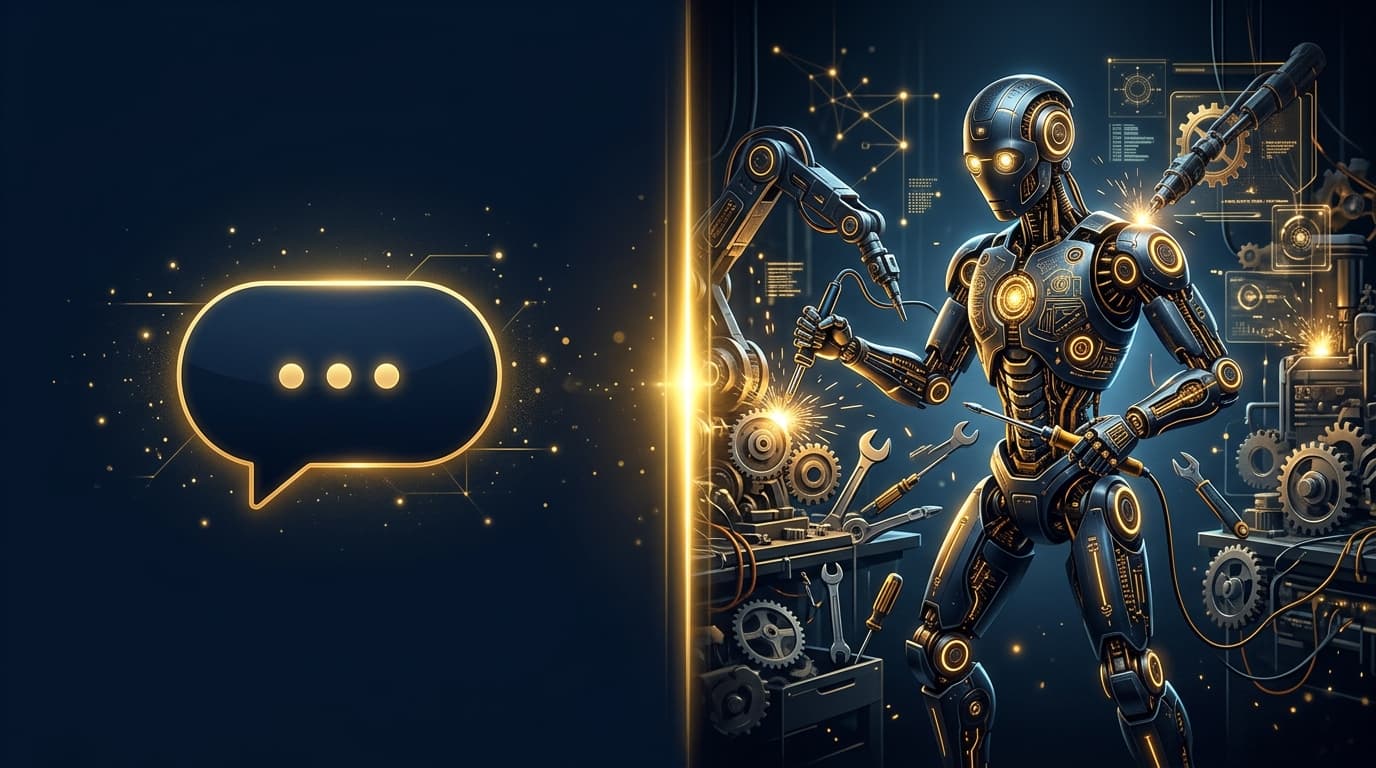
The distinction is action. A chatbot answers questions using the context in the conversation. An AI agent acts on those answers using connected tools and data.
The most useful mental model: a chatbot tells you the answer; an agent does the work. A support chatbot explains your refund policy; a support agent reads a refund request, checks the order in your database, and initiates the refund after approval.
- Chatbot: conversation only — answers questions and routes requests
- AI agent: conversation + tools — updates CRMs, creates tickets, sends messages, runs workflows
- AI agent: can search your documents and data sources to ground its answers
- AI agent: remembers context across a whole task and picks up where it left off
How AI Agents Work Under the Hood
Agentic AI systems loop through observe → decide → act. The agent receives a goal, plans the steps, calls the right tool for each step, checks the result, and iterates until the objective is complete. Production systems add guardrails: permission boundaries, human-approval triggers for sensitive actions, audit logs, and cost controls.
This is why a dependable AI agent is an engineering project, not a prompt. The model is the brain, but the tools, permissions, and safety checks are what make it safe to run in a real business.
Business Use Cases for AI Agents
The highest-ROI agent applications replace repetitive manual workflows. Sales teams use agents to qualify inbound leads around the clock and book meetings automatically. Support teams use agents to resolve routine tickets, search internal documents, and escalate only what needs a human. Operations teams automate data entry, report generation, and follow-up emails that once consumed hours every week.
A well-scoped agent typically pays for itself by removing a few hours of manual work every day. That is why AI agent development has become the fastest-growing request we receive from business owners.
Frequently Asked Questions
What is the main difference between an AI agent and a chatbot?
A chatbot answers questions in a conversation. An AI agent takes action — it updates systems, creates records, sends messages, and completes multi-step workflows using connected tools.
Do AI agents need a lot of training data?
No. Business AI agents run on foundation models that are already trained. Your documents and business rules are connected through retrieval (RAG) rather than custom model training.
Can an AI agent connect to our existing software?
Yes. Agents integrate with CRMs, email, databases, helpdesks, and APIs — either through official integrations or custom connectors we build.
Engineering & Architecture Team
Founding Team & Lead Engineers · HS Buraq Logix
15+ years combined experience designing and shipping AI agents, full-stack products, and enterprise software systems. The engineering team at HS Buraq Logix builds autonomous agents, web platforms, and scalable backends for businesses worldwide.